Europe’s 2025 Beauty Market: A Buying Checklist for Hair Tools
A useful hair tool enquiry starts with a named market, an intended user and a confirmed packing unit. Market size can provide context, but it cannot select the right roller, brush or colouring tool for your customer. For European sourcing, turn a broad market opportunity into a model-level brief that buyers and suppliers can check together.
What the 2025 market data does—and does not—tell buyers
Cosmetics Europe reports European cosmetics and personal care retail sales of €110 billion in 2025, including €20.3 billion in hair-care products. Its country totals include Germany at €18.0 billion and the United Kingdom at €14.7 billion. These figures describe cosmetics and personal care markets; they are not a sales estimate or demand forecast for hair tools. Source: Cosmetics Europe, Our Industry, based on Market Performance 2025.
Our sourcing recommendation is to name the destination country and channel before comparing quotations. A salon distributor, a retail brand and an online seller can need different assortments, sales packs and replenishment records even when they select the same basic tool.
1. Define the market and channel before the product list
On smaller screens, swipe the table sideways to view all columns.
| Buying decision | What to put in the enquiry |
|---|---|
| Destination | Country or countries, rather than “Europe” alone; identify any separate market versions. |
| Customer and use | Salon professional, retail shopper or other intended user; explain the task the tool should perform. |
| Sales channel | Salon distribution, physical retail, e-commerce or a combination, with any channel-specific pack requirements. |
| Order unit | State whether each quantity means an individual tool, a bag, a box or a complete set. |
| Replenishment | List repeat-order models separately from new items and identify the sample or packing version to repeat. |
2. Compare tools by the job and the exact model
Similar photographs do not establish the same dimensions, material or packing. The examples below are catalogue references for a discussion, not a recommended assortment for every European market.
On smaller screens, swipe the table sideways to view all columns.
| Example | Selection point | Confirm before ordering |
|---|---|---|
| PV 47622 self-grip rollers | Catalogue size: 13 × 63mm. Specify the roller size and how many rollers belong in the sales pack. | Match the model, colour and pack count to the approved sample. |
| WB 851 round brush series | Plastic-handle aluminum nylon round brushes in 15–50mm catalogue diameters. | Order each diameter explicitly. This is a model series, not an eight-brush set. |
| HS 529-01 colouring paddle | Catalogue size: 200 × 102mm, with a short handle. | Check working dimensions and the required sales pack; catalogue carton packing is 250 paddles. |
3. Approve the sample and packaging as one version
A product sample does not define every label, bag or carton. Keep one approval record linking the model, dimensions, material, colour, sample reference, sales-pack quantity and carton quantity. Add the artwork filename and revision when branding or printed packaging is involved.
For a range containing several sizes, confirm which requirements apply to all models and which vary by SKU. This helps avoid a large-diameter brush being packed or labelled as another size, or a per-piece quotation being compared with a per-bag price. Agree any inspection criteria with the sample rather than relying on a general statement such as “same quality.”

4. Make repeat orders traceable
Keep the supplier model and your own SKU in separate fields. Record the selected size, colour, material, sales-pack unit and carton quantity on the purchase order. If the artwork, pack count or assortment changes, issue a new revision and confirm whether the previous sample still represents the order.
Discuss target shipment dates and repeat-order needs when requesting a quotation. Available customization, order minimums, sample arrangements and production timing are confirmed for the specific project. Market statistics alone cannot establish a delivery schedule or an appropriate stocking quantity.
How Tianba can support your buying brief
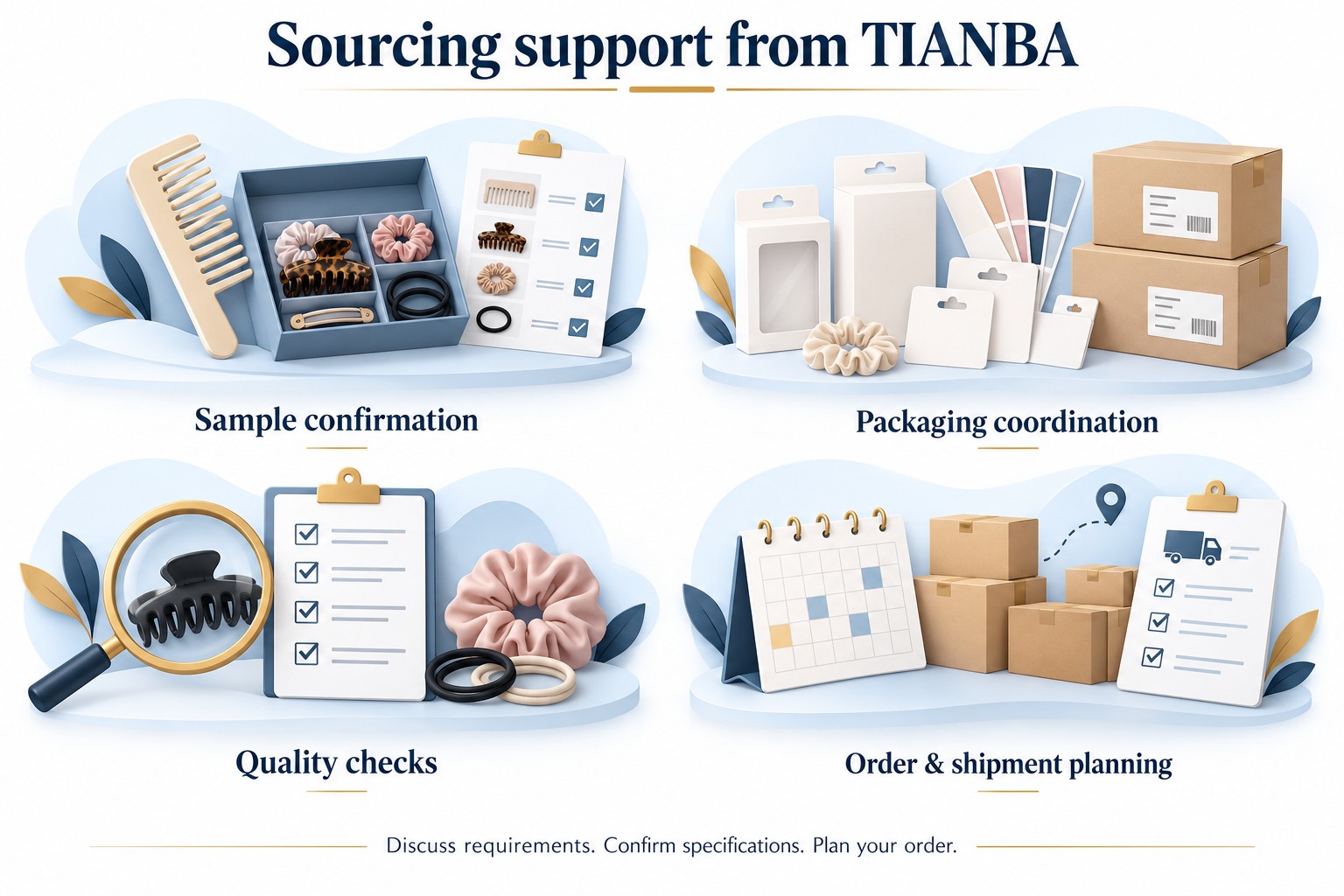
Guangzhou Tianba Beauty & Cosmetic Co., Ltd. supplies rollers, combs, brushes, clips, colouring tools and salon accessories. Tianba can review catalogue options or references, coordinate sample confirmation, discuss logo and packaging requirements, and agree order-specific inspection and packing details. Clear inputs make it easier to compare the same specification and reduce avoidable purchasing misunderstandings.
For an enquiry, send the destination market, sales channel, model numbers or reference images, quantity by SKU, and required sales pack. Include existing artwork and sample references where available. Discuss your hair tool sourcing brief with Tianba, or read our sample and packaging approval guide.
Buyer questions
Do the European hair-care figures forecast demand for brushes or rollers?
No. They are cosmetics and personal care market data. Use them as background, then validate your tool assortment against your customers, channel and model-level requirements.
Can I combine different brush or roller sizes in one enquiry?
Yes. List every model or size and its quantity separately, and state whether you need individual packs or a combined set. Tianba can review the proposed assortment and packing requirements for a quotation.
What should a repeat order refer to?
The model, your SKU, the approved sample reference, the size and material, and the approved artwork and packing revision. Flag changes before confirming the order.
Market source checked 25 October 2026: Cosmetics Europe — Our Industry / Market Performance 2025. Procurement recommendations and catalogue examples are Tianba’s own practical guidance; they are not conclusions from the market report.
2026 US Hair Care Trends: A Buying Brief for Hair Tools
Related Article